The evolving integration of artificial intelligence (AI) into journalism has generated a growing body of research focused on its applications, implications and risks. However, one question remains insufficiently addressed: how do journalists actually accept, negotiate or refuse these technologies in practice?
Although the acceptance of technology is often considered in terms of efficiency or technical performance, this overlooks the fact that the field is characterised by robust professional norms, ethical constraints and epistemic responsibilities. In this context, I have developed the TAM-J model, a novel theoretical extension of the Technology Acceptance Model (TAM).
Developed in the late 1980s, TAM is one of the most widely used frameworks for understanding technology acceptance. It posits that people tend to adopt a system when they can clearly see its benefits, and it does not unnecessarily complicate their work. These perceptions influence their attitudes towards the technology, which affects whether they use it in practice.
This explanatory logic has proven robust across domains. However, when applied to journalism, it reveals several limitations. Journalism is organised not only around workflows and productivity gains, but also around values such as accuracy, accountability and editorial autonomy. Therefore, technology acceptance cannot be reduced to a functional or instrumental evaluation.
Research in journalism studies and science and technology studies (STS) has long emphasised the socio-technical nature of technological change. Technologies are embedded in specific organisational, cultural and symbolic contexts, and their meanings are negotiated within professional practices. Similarly, research into human–machine communication has demonstrated that interactions with technology encompass not only usability considerations, but also cognitive, emotional, and interpretive elements.
In journalism, AI is often touted as a means of streamlining work, automating repetitive tasks and boosting productivity. However, it also raises several concerns. Questions around reliability, transparency and bias are difficult to ignore, as is the broader issue of the impact of these systems on professional authority. Even when journalists recognise the practical value of such tools, this does not necessarily translate into trust. Their use is still shaped by both epistemic and ethical doubts.
Rather than breaking away from the original model, TAM-J builds on its foundations while adapting them to the specific context of journalism. Although perceived usefulness and perceived ease of use still play a central role, they are considered alongside a wider set of factors reflecting the professional, organisational and cultural environment in which journalists work.
The first important dimension concerns external variables. These include demographic factors, such as professional background and geographical location, as well as organisational factors, including newsroom policies, training and managerial support. Cultural factors also play a significant role, particularly regarding professional identity, educational backgrounds, and familiarity with technological tools.
Beyond these aspects, the model raises questions of representation and ethics that are often left implicit in more technical approaches. The way AI is discussed and conceptualised is important. AI can be viewed as an opportunity, a threat or simply another tool, and these perceptions shape how journalists engage with it in practice. Ethical concerns also play a central role. Issues of trust, transparency, and responsibility are not just abstract principles insofar as they are likely to influence whether a system is considered acceptable.
TAM-J considers the concept of openness, recognising that not everyone engages with new technologies in the same way. Some people are more inclined to explore and test new tools, gradually integrating them into their routines. Others are more cautious, placing greater value on stability, control and established practices. People’s attitudes to innovation are likely to impact how they understand their experiences of technology. This will determine whether they keep using it.
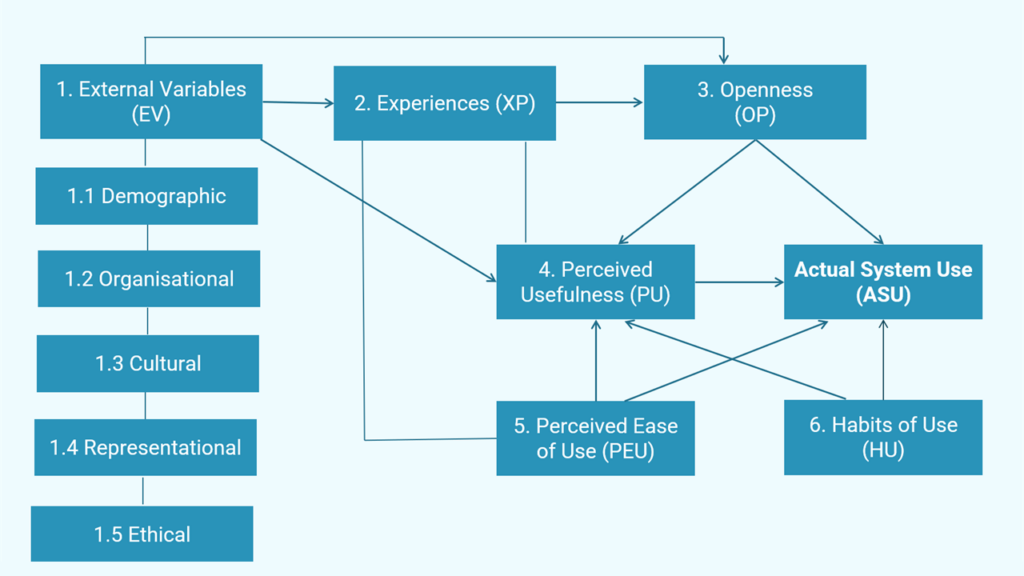
In addition to these factors, TAM-J introduces the concept of habits of use. Journalism is structured around routines, deadlines and established workflows. Therefore, the integration of a technology is not limited to the initial decision to adopt it, but involves its gradual incorporation into everyday practices. Repetition, familiarity and task distribution shape perceptions of usefulness and ease of use over time.
These variables highlight that the acceptance of technology in journalism should be understood as a context-specific process. This aligns with the long-standing research tradition of the sociology of use. For example, a system may be considered useful, but still be rejected for ethical reasons. Similarly, a system may be easy to use yet marginalised because it conflicts with professional norms. Conversely, practices may evolve as technologies become embedded in routines, leading to silent or gradual adoption.
This challenges the assumption that adoption is a linear process, emphasising the importance of considering the broader context in which technologies are introduced. Consequently, the focus shifts from whether or not journalists use AI, to how they interpret, negotiate and integrate it (or choose not to) within their work practices. This raises questions about the conditions under which AI is used, and the factors that shape its incorporation into journalistic practice.
As the TAM-J framework draws on extensive insights from science and technology studies regarding the formation of use, it enables a more nuanced understanding of users’ relationships with technology. Rather than reducing use to simple adoption, the framework allows for distinctions between functional use, situated practice, and broader adoption processes, all of which require careful, contextualised analysis. Accordingly, it recognises the formation of use as a complex process shaped by both endogenous and exogenous factors operating across individual, social, cultural, and organisational contexts.
Read more: AI in journalism: The differences between use, practice and adoption
The TAM-J framework is not intended as a predictive tool in the strict sense of the word, nor as a closed model. Rather, its purpose is to provide an analytical structure capable of capturing the multitude of factors that influence the acceptance of technology in journalism. It can be used in quantitative studies, for example, through survey-based approaches and structural equation modelling, as well as in qualitative research.
In a recent paper on the acceptance of generative AI in European fact-checking, I mobilised the TAM-J. In this study, the framework served as the basis for a methodological approach to survey construction and for guiding the analysis.
Dierickx, L., & van Dalen, A. (2026). Using It but Not Trusting It: Technology Acceptance and Generative AI in European Fact-Checking. Emerging Media, 27523543261449974. https://doi.org/10.1177/27523543261449974