My latest academic publications examine the joint transformation of fact-checking and generative language models. They connect three levels of analysis: the redefinition of the concept of « fact’ through the notion of « emergent facts »; the professional use of AI, characterised by limited trust and systematic control; and prompting strategies that prioritise simplicity as a robustness factor. These data show a pragmatic integration of AI into verification practices, without transferring epistemic authority to the systems.
Towards a situated factuality
The emergence of generative language models calls into question the traditional definition of a fact as stable, verifiable data, regardless of its context of production. The statements produced by these systems are based on probabilistic logic and generate plausible formulations, but their empirical basis may be indirect, incomplete or even absent. Within this framework, factuality becomes a gradual concept dependent on the conditions of generation.
Therefore, the best way to understand facts is to view them as the outcome of the interaction between training data, model design and a user’s prompt. This process introduces some uncertainty. As the system generates statements based on learned patterns rather than direct access to reality, it is not always possible to fully trace the results back to stable, verifiable sources.
Dierickx, L., Opdahl, AL, Bjerknes, F., & Lindén, CG (2026). What is a fact in the age of generative AI? Fact-checking as an epistemological lens. Information, Communication & Society , 1–18. https://doi.org/10.1080/1369118X.2026.2630697
The cautious integration of AI into fact-checking
In professional fact-checking, generative language models are regularly used, but only in a strictly controlled manner. They are used for peripheral tasks such as reformulation, synthesis, brainstorming and exploratory research, while verifying and validating facts is carried out entirely by humans. This division reflects a logic of instrumental use. AI is utilised to accelerate and support the work without ever becoming a source of epistemic authority.
This approach is based on limited trust and systematic control. All generated outputs are cross-checked, contextualised and verified before use. Users acknowledge the efficiency gains while maintaining high editorial standards.
The Technology Acceptance Model adapted for journalistic contexts (TAM-J) provides a theoretical framework that demonstrates the integration of generative AI depends on more than just ease of use and perceived usefulness; organisational, ethical and representational dimensions also play a part. Although perceived usefulness (in terms of time savings and efficiency) coexists with low epistemic trust, considerations of editorial responsibility and transparency play a central role in limiting its use. Thus, the model helps us understand why, despite being widely used, AI is not fully accepted in terms of trust: its integration stems more from a logic of constrained performance than epistemic commitment.
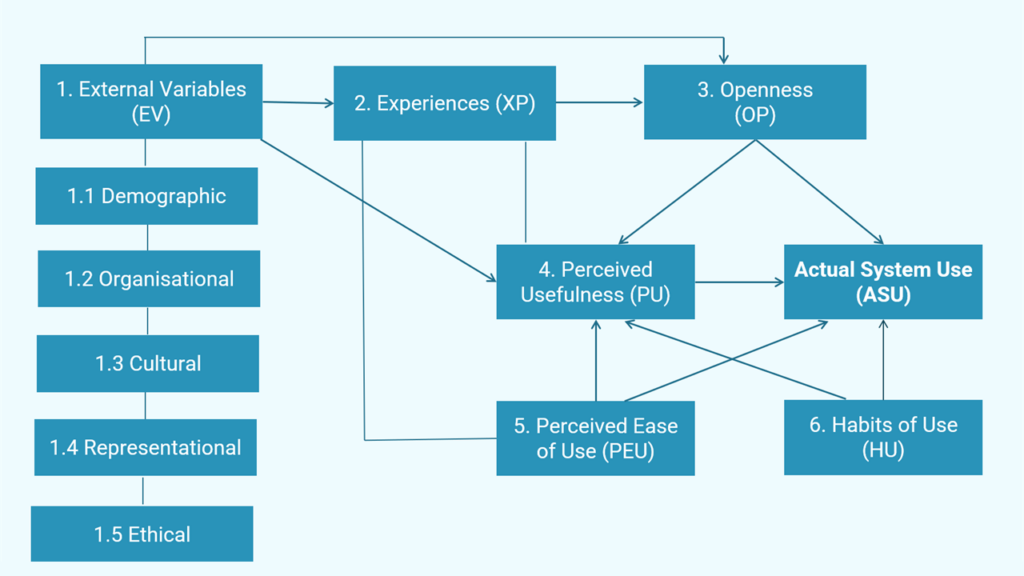
Dierickx, L., & van Dalen, A. (2026). Using it but not trusting it: Technology acceptance and generative AI in European fact-checking. Emerging Media . https://doi.org/10.1177/27523543261449974
Prompting strategies: simplicity as a principle of robustness
Analyses comparing different prompting strategies have demonstrated that, for model performance, the clarity and structure of the instructions are more important than their sophistication. In condensation, generation and evaluation tasks, simple, direct formulations produce more stable and reliable results than more complex approaches, such as step-by-step reasoning or decomposition chains.
More advanced methods only yield meaningful improvements in situations that specifically require structured reasoning, particularly in assessment contexts. In other cases, they can increase response variability and add unnecessary complexity without consistently improving overall quality. These findings suggest that interactions with language models work best when they are efficient, using fewer precise words.
These results are based on a comparative approach, using seven prompting techniques across four language models. Performance was measured on tasks representative of AI-assisted fact-checking, including information condensation, content generation, and statement veracity assessment. The analysis is based on a corpus of over 2,000 generated outputs, which are compared for stability, consistency and suitability for the task.
This approach isolates the effect of prompt formulations on response quality, revealing consistent patterns that transcend model differences. It also demonstrates that prompt engineering techniques are of limited value in non-expert contexts. Without a deep understanding of the models or advanced formulation logic, the expected benefits of complex strategies diminish or disappear entirely.
Under these conditions, simple, practical approaches are most effective, reinforcing the idea that performance depends more on clarity of intent than on technical sophistication of instructions. However, this does not address the models’ inherent limitations, which can be understood through the lens of emergent phenomena (see the beginning of this post).
Dierickx, L., Opdahl, AL, & Lindén, CG (2026). Strategic Simplicity Gets the Most: Evaluating Prompting Techniques in Non-Expert AI-Assisted Fact-Checking. International Journal of Human–Computer Interaction , 1–16. https://doi.org/10.1177/27523543261449974
Acknowledgement: This article was automatically translated using Google Translate and subsequently edited by a human with assistance from Grammarly and DeepL Write.